

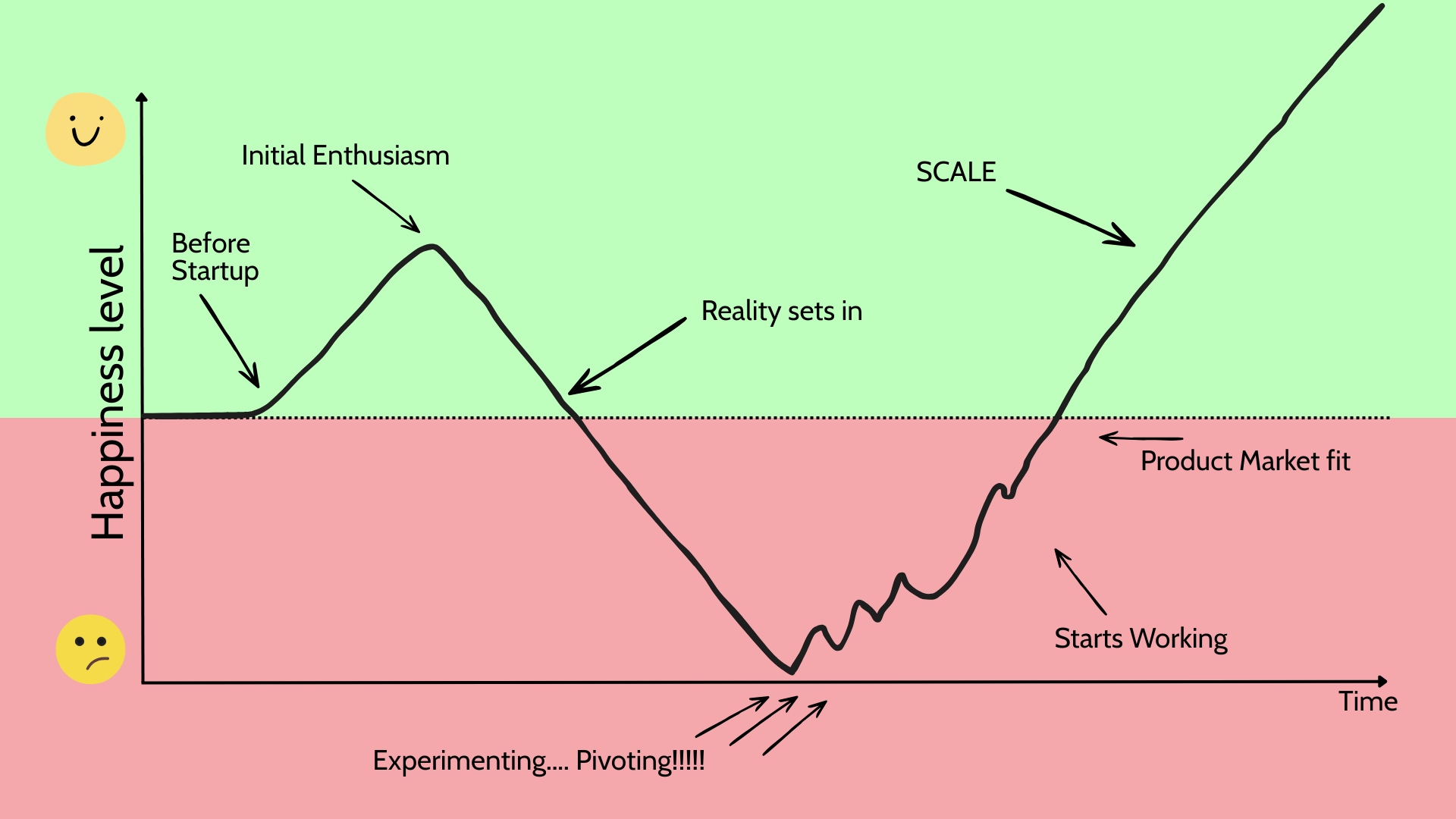
The Emotional Rollercoaster of Entrepreneurship
At my first startup, our very first customer was Diageo’s Captain Morgan Spiced Rum. We hit it BIG right out of the gate. After three years, it turned out that this company was the greatest company that never was. Despite our early success, working through a wide variety of projects, and weathering the 2008 financial crisis, it just wasn’t working. We ended up shutting it down, and it was time for me to move on to something else.
Like all startups, our company was a roller coaster of ups and downs. After multiple years of feeling like I was just on the verge of massive success, I was still trying to afford a very meager college lifestyle. I had sacrificed so much over the previous years. I chose to miss out on studying abroad, lucrative internships, and social situations. It turns out that if you don’t go to certain friends’ weddings, bachelor parties, and other social gatherings, you don’t always stay friends with them. I just couldn’t afford it because everything I was doing was focused on making our company work. I was essentially, out of all my friends, the broke one.
Of course, I knew in my soul that it would all be worth it in the end. What we were building was amazing, and we had already proven the business worked, could rake in money, and would eventually achieve success. Until it didn’t, and clearly it wouldn’t.
I was done.
I wanted nothing to do with startups, being a founder, and the last thing I wanted was the continued responsibility of being over other people. I was a software engineer, and I was building mobile apps before the iPhone was released. When it came out, I was building mobile apps from the very first week the development kit was released. This was at a time when the mobile app world was about to explode, and we saw it coming. We were way too early in our business, and after years of learning how to run a company, I decided I didn’t want anything to do with it in the future.
With my skill set, I could land any job in the year after I graduated with my master’s degree. I already had my bachelor’s degree in computer graphics with a specialty in Interactive Multimedia and Gaming, plus I had developed multiple mobile apps for clients. I just needed to gain some more experience working for someone else.
I just had to show that I was a great employee, a good enough engineer, and hungry to work for someone else. I was beyond ready to tell everyone I would never start another company again, and I almost dreamed of the question that would be asked where I would get to share my desire to never be an entrepreneur again.
My next step was to find a job that I would enjoy. I wanted experience joining a company, being part of a team I didn’t control, and learning from others who were more experienced than I was. I started researching companies around Purdue and found one that looked very interesting. They were a custom software company that was not too far off from my first business. We focused entirely on mobile apps, games, and websites for marketing agencies and large companies. This company built software for anyone and did lots of interesting projects.
I saw that someone I knew was friends with one of the founders of the company. I reached out and told them what I was looking for. Within an hour, I got a call and had an interview with the company. I sat down and wrote up a new résumé and printed it on high-end paper at OfficeMax. Remember them? I practice-interviewed with my father, who worked as a director of HR at large companies and hired top talent. I did programming test reviews and felt prepared by the time we met.
The interview was completely different than anything I expected. They didn’t ask to see my résumé. I had to hand it to them. They knew who I was and the work I had already done. Instead of a traditional interview, they asked me why I wanted to work for them. I will never forget what I told them.
“Being a business owner is not for me. It is way too stressful, and I clearly wasn’t good enough at it to be successful. I just want to work for someone else, do awesome projects, and be an awesome employee for a cool company like yours.”
They wanted to schedule a second interview with the team a few days later. That meeting went extremely well. I immediately clicked with the team, and they were excited about everything I already knew. They were just getting into mobile apps, and before our lunch meeting was over, I had already solved three of their biggest iOS app bugs they were seeing. When people tell you to find a good “fit” with the company you apply for, this was clearly it.
Before I left, the CEO showed me the office I would be in, asked what kind of setup I wanted for my workstation, and everyone seemed very excited for me to start. He asked me to come back on Monday to hash out any other details.
I was thirty minutes early to that Monday morning meeting and walked in excited to see everyone again. Immediately, everyone was telling me good morning, and it looked like they were excited to see me. I went into the CEO’s office, and we started chatting. One thing we hadn’t discussed was money, and this was expected since they wanted to see if I was a good fit with the company.
At this meeting, they asked how much I was looking to earn as a full-time employee.
I told them that I would be fine with at least $17 per hour.
Looking back, the insanity of what I was offering is humorous. The CEO looked at me, shocked, and kind of chuckled. He said, “You know you are worth more, right?”
I told him, “I know I can probably earn more, but I really want this job. I want to prove that I can do amazing things for this company, be part of a successful team, and be part of a successful company. I am willing to start there, and hopefully I can grow into a larger salary.”
He told me that they only pay full salaries and benefits and smiled at me. We went over quite a few things on operations, what they expect with vacation time, and more. He said they typically send a full offer by email and are available to discuss any questions I have once I’ve had time to review it.
As the meeting ended, he said something else I will never forget.
“You are going to be fine. You should know you’ll be great in anything you do.”
This was awkward. Was I going to be fine at his company? Was I going to be fine in what I did for him? I was very confused, but I did the only thing I could think of. I thanked him, shook his hand, and left to wait for this employment offer.
I waited for their email the whole week. When it didn’t come, I thought they were probably having to go through a bunch of work with legal and accounting before they sent it. After two weeks, I emailed them asking about the offer. No reply. After three weeks and no responses to my emails or calls, it hit me that they weren’t going to hire me.
I was shocked and devastated. This was everything I knew I wanted. With all my experience, I could get any job I wanted, right? Right? What the heck was going on?
The self-doubt hit me hard during this time. I couldn’t understand why they wouldn’t hire me. I talked to everyone to try to understand this because if I couldn’t get this job, how could I get any job? I was in a bad place mentally and financially. Bills were coming due, and I was worried I wouldn’t be able to pay the next month’s rent. I had less than three weeks to figure something out. Yet there I was — I couldn’t even get employed by the “perfect fit.”
I’ve thought about this moment a lot as a turning point in my life. I look back at it fondly because of the impact it had on me.
Yes, things turned out well for me, but I often ask, “What if he hired me?”
Where would my life have gone, and what direction would I have ended up? Would I have hated being an employee, or would I have loved being a part of that team? I am sure my career would have been much easier and more straightforward. But would I have been truly happy? Or was I always destined to be an entrepreneur? These aren’t questions I can answer because this is not what happened.
Instead, I didn’t get hired. I had bills to pay, and the only option in my mind was to go find work. I didn’t think I’d earn enough within the timeline I had at a traditional job. Instead, I reached out to everyone I had worked with in the past. I emailed them all, simply saying that while my previous company didn’t work out, I was going off on my own to offer freelance work. Did they have any projects for me?
Amazingly, a friend from a past contract had a project they were struggling on. They needed someone to help build a quick website. They asked how much I needed to do the project. Without even thinking about it, I said $1,700. This was my rent, bills, and enough to buy some food. They looked surprised and agreed. However, I told them I needed at least half up front and a guarantee to pay when I delivered, even if it was before the deadline. I couldn’t wait for the client to pay them. Luckily, I was so cheap that they were fine with this. Realistically, they were probably looking for $3,000 to $4,000 for this work. I knew this at the time, but I was desperate.
I barely slept while cranking out the work as fast as I could. I had three weeks to do the project, but I delivered it in three days. They wrote me a check, and relief finally came when I deposited it in the bank. But I wasn’t done. I had only bought myself three days. After a good night’s rest, I had an email from the client asking if I could take on more projects.
Clearly, the answer was yes, and I grinded for the next few months with multiple clients. I severely undervalued myself and undercut the competition way too far. But I had money to live on, and more than I had made in quite some time.
Then one of my clients wanted to make a referral. He asked me what my company’s name was. I told him I didn’t have one and that I was just doing work for others. He looked at me confused and said:
“I hate to break it to you, but if you are doing this much work, you have a company.”
He was right. Before I even realized it, I was a founder again with a new company. I had even subcontracted some of the work out to people who had worked for me previously. At first, I was in denial about it. Then I gave in and realized that I was running another company.
About a year later, a friend called me. He had found success in Silicon Valley as an employee and was leaving his job to start his own healthcare tech startup.
He asked one simple question. “Are you in?”
I paused for a second. After the craziness of the last year, I had to be very honest with myself before jumping into an even larger health tech startup.
I simply said, “Heck yeah!”
From that point on, I was a startup founder. To date, I’ve started six companies and a nonprofit called FoundersForge. I’ve had four epic failures, one amazing success, and one that is just now starting up. I’ve worked with huge and small clients. An app I built was used by the U.S. Olympic Diving Team, and I’ve even helped build software that was used in White House briefings to the president.
It was that one pivotal moment that set me on this path, and I am so grateful that he told me, “You’ll be fine,” instead of, “You’re hired. See you Monday.”
I don’t know why he didn’t hire me. I should reach out and find out if he even remembers me. Everyone has a different theory. Maybe when I asked for $17 an hour, I was clearly undervaluing myself. Maybe he thought I would ask for too much later. Friends suggested I would have upstaged him, or someone on the team didn’t like me. If I had to guess, I assume it was clear to him that I was going to leave and do my own thing. Maybe he thought I wouldn’t like working for someone else or that I’d become a competitor who took his clients. Maybe I will never know.
What I do know is that this moment taught me some valuable life lessons that I needed in order to achieve success later on in my career:
Necessity Makes a Startup Work
When I was lost, scared, and had bills to pay, my choices were limited. This can be the biggest motivation for an entrepreneur. Sometimes, it’s these moments that make a startup truly take off. When a founder tries to solve problems with money, especially second- or third-time founders, they often run into problems. Their lack of necessity reduces opportunities for solving problems creatively and taking immediate action. Necessity is often a driving force for a founder.
Some Things Are Only Possible in Entrepreneurship
When I think back to what happened, I clearly put all my eggs in one basket and took rejection too hard. This was a single data point that didn’t hire me. I likely could have gotten hired at any number of places near me. The incredible thing is that when I was up against a wall, I was able to raise $1,700 in less than a week. I ended up making $10,000 by the end of the month. What other legal job enables you to do this on a whim? Not many. This is the beauty of entrepreneurship. It can be very difficult to be successful, but it can also be possible to make a lot of money very quickly. Some things, for better and for worse, are only possible when you are an entrepreneur.
The Network and Reputation You Build Is Everything
The years I spent trying to make my first company a success were not wasted. I didn’t realize it at the time, but I was building an incredible network in my undergrad. I was only able to react to the needs I had because I could reach out to everyone I had worked with before. Anytime business was slow, I would do the same thing. I would reach out and let it be known that I was looking for more work. I also asked for referrals from past clients. It was amazing how often this translated into sales.
The Mental Health Side of Being a Founder Is Important. Never Ignore It.
There is no shortage of people talking about mental health with startups. Being a founder can be a very lonely road. When things are not going well, it’s difficult. When things are going great, it’s even harder. Only other founders understand this and can relate. Friends, family, and other people in your life would simply get a new job and don’t understand why you do not.
The reality is that founders need to be cognizant of their own mental health. If you don’t understand how you react at your highs and your lows, you will soon find out. Understanding this can be critical to your success. Sometimes you must work through rough times to get through them, as there is no way out. Knowing other founders and being open with them is like a weight being lifted. This is why we focus so much of our energy on building a startup community, not an ecosystem. Community is true support and is there for you when you need it. Find it and be a part of it for your own sake.
What Happens Now May Be What Sets You Up for Later Success
Looking back, I can trace my career through these pivotal moments. I can see the journey I have taken, and it is incredible how the things I struggled with, failed at, and succeeded in led me to where I am today. If I could go back in time and give myself one piece of advice, it would be this: Know that what you are doing today might just be what leads you to future success. Give every day your all and keep moving forward no matter what. It will be worth it.
Unfortunately, we don’t get to visit our past selves, so we often struggle through moments where we wonder why we have to go through such hard times. But trust me, no matter how it goes down, what you are working on today will be part of the future success you achieve. Do your best and own your future.
Yes, things worked out for me. Was it enough? I realized recently that it never will be. The part of my entrepreneur story I love is the journey to get there. When I’m old and being taken care of, I’m sure I’ll have a startup idea for that. When I leave this world, I’m sure I’ll wish I started one more company and had one more success. But I’ll always know deep down that the journey is what I seek, not the success.