Every time I think about access to real food in rural Appalachia, I think about the math people have to do just to get it. A Saturday farmers market that's an hour and twenty minutes away. A county with one chain grocery store and three dollar stores. A community of working people who want better, but with food access so far away and gas prices what they are, finding quality food is hard and costly.
That gap is real. I've heard it talked about. I've seen it play out. And I've always wondered what it would take for someone to actually solve it — not theorize about it or write a grant about it, but show up with a converted horse trailer and a freezer full of pasture-raised chicken. Rebecca Kilgore is that person.
A Proposal, a Pasture, and a Turkey Feather
The name Turkey Feather Farm doesn't come from the animals they raise, though they do raise a lot of chickens. It comes from the day Rebecca's husband Jonathan proposed to her in the back pasture of a farmhouse they didn't technically own yet. They'd made an offer, were waiting to hear back, and decided to go for a drive and just look at the place. One thing led to another. They found themselves having a picnic on the front porch, then walking the dirt road out back. Rebecca was twirling a turkey feather she'd picked up off the ground when Jonathan got down on one knee. He was nervous enough that the words barely came out. But they did, and she said yes, and the farm became theirs a short time later.
"We may have met a few years before that moment, but our true adventure began that day, in that field, in those few words my husband got out because he was so nervous to ask me to marry him." — Rebecca Kilgore, Founder, Turkey Feather Farm
They bought the farm in September of 2023. By the time she sat down in the first session of the Dickenson County Avante Bootcamp cohort, she had chickens, a vision, and a question she hadn't fully answered yet: how do you actually build a business out of this?
The Problem She Was Actually Solving
Rebecca grew up in the suburbs of New Jersey, but spent her teenage years working at a farmstand and eventually moved to a 16-acre hobby farm with chickens, goats, and alpacas. Farming was always in the background. It didn't become a mission until her early twenties, when she started learning about where her food actually came from.
By the time she and Jonathan were settled in Dickenson County, she knew the problem firsthand. The farmers markets 50 miles away were inconsistent. Producers didn't show up regularly. The weekday hours didn't work for working families. The best market in the region required a ninety-minute drive each way. And Dickenson County itself — ranked in the top three poorest counties in Virginia by median household income — was down to one chain grocery store and a handful of dollar stores.
They started growing their own food because they couldn't reliably find what they wanted nearby. Then the question shifted: what if they could make it easier for everyone else?
"It shows in the litter strewn across front yards and roadsides. It shows in the pile of little snack cakes and soda pop weighing down in their shopping buggies. It will be challenging to break that mindset and show people that what they do and what they eat really does matter on multiple levels." — Rebecca Kilgore, Turkey Feather Farm
"By curating a welcoming space where people can learn about the food in the grocery store versus the food off the farm, we can inspire positive life habits." — Rebecca Kilgore, Turkey Feather Farm
A Market on Wheels for People Who Work
The mobile farmers market idea came from thinking through every obstacle that stood between a working family in Dickenson County and a bag of real food. Drive too far. Market isn't open. Don't know what'll be there this week. Not worth it. A mobile market removes most of those barriers. It shows up in town, on a consistent day and time, in a place people already are. No hour-and-a-half drive. No guessing what vendors showed up this week.
A one-stop setup with meats, eggs, produce, honey, baked goods, herbs, and dried goods — much of it grown at Turkey Feather Farm, the rest sourced from neighboring local producers on consignment. The unit itself is still being finalized, but Rebecca has a clear vision: a converted horse trailer with a concession window for frozen meats, a table or two outside for everything else. Something that looks like it belongs on a farm. Something people are curious enough to stop for.
"You can spend a little more on good food now, or spend it on medical bills later." — Rebecca Kilgore, Turkey Feather Farm
What the Avante Cohort Did for Her
Rebecca almost missed the application deadline. She saw the Avante Bootcamp posting on Facebook a few days before the cutoff. She applied mostly to learn — she didn't expect to do anything with the business until she felt "ready." The Dickenson County cohort ended up being the largest in Avante's history.
The program gave her more than tools. It gave her a framework for thinking about her business differently. Start with the problem, not the solution. Know what you're actually solving before you get excited about what you're selling. She also found something she didn't expect in her cohort peers: people at different stages, with different backgrounds, who cared about each other's success. Not competitive. Just honest.
When pitch night came, she was ready. She laid out her problem, her solution, exactly where every dollar of the requested funding would go, down to each piece of equipment. She brought a profit projection she described as "very honest." She won first place — $16,000 out of $50,000 given away total.
"It wasn't until I got home later that night that it sunk in and I was like, 'Oh shucks, I really gotta do this now.'" — Rebecca Kilgore, Turkey Feather Farm
- Know your problem cold. Don't start with what you're selling. Start with what's broken and why your solution fixes it.
- Be specific about money. Don't say you need capital for "equipment." Name the equipment. Name the price. Judges notice the difference.
- Don't pad your projections. An honest number you can defend is worth more than an exciting number you can't.
- It's okay not to know everything. "That's a great question — can I get back to you?" is a better answer than a confident wrong one.
Building Slow on Purpose
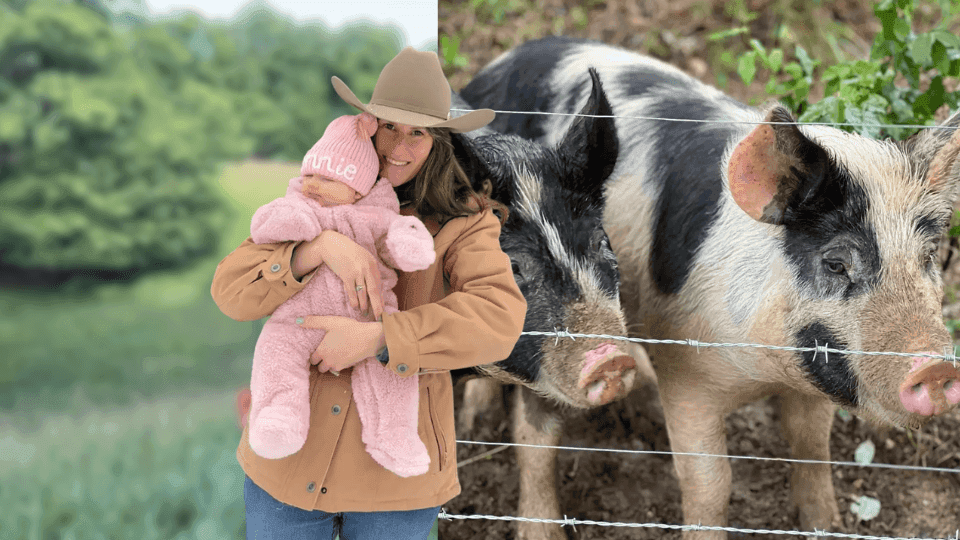
Rebecca is not trying to do everything at once. She still has a full-time job as Director of Parks and Recreation for a local city. Summer is her busiest season, which is also when the farm needs the most attention. She has a six-month-old. She is, as she put it, a wife, a new mom, a daughter, a sister, and an active church member.
She's watched homesteaders burn out in six years — too much too fast, overwhelmed, then done. Her father's voice is in her head: "There's only one way to eat an elephant, and that's one bite at a time." So she's building slow. Get the mobile market right before anything else. Show up consistently. Earn the trust.
Her Turkey Feather Farm Facebook page went up before she had a single product to sell, on the advice of one of the Avante judges. She posts about gardening and cooking and farm life. People are finding her. Connecting. That's the community she's building, and the mobile market is just the physical version of what she's already creating online.