

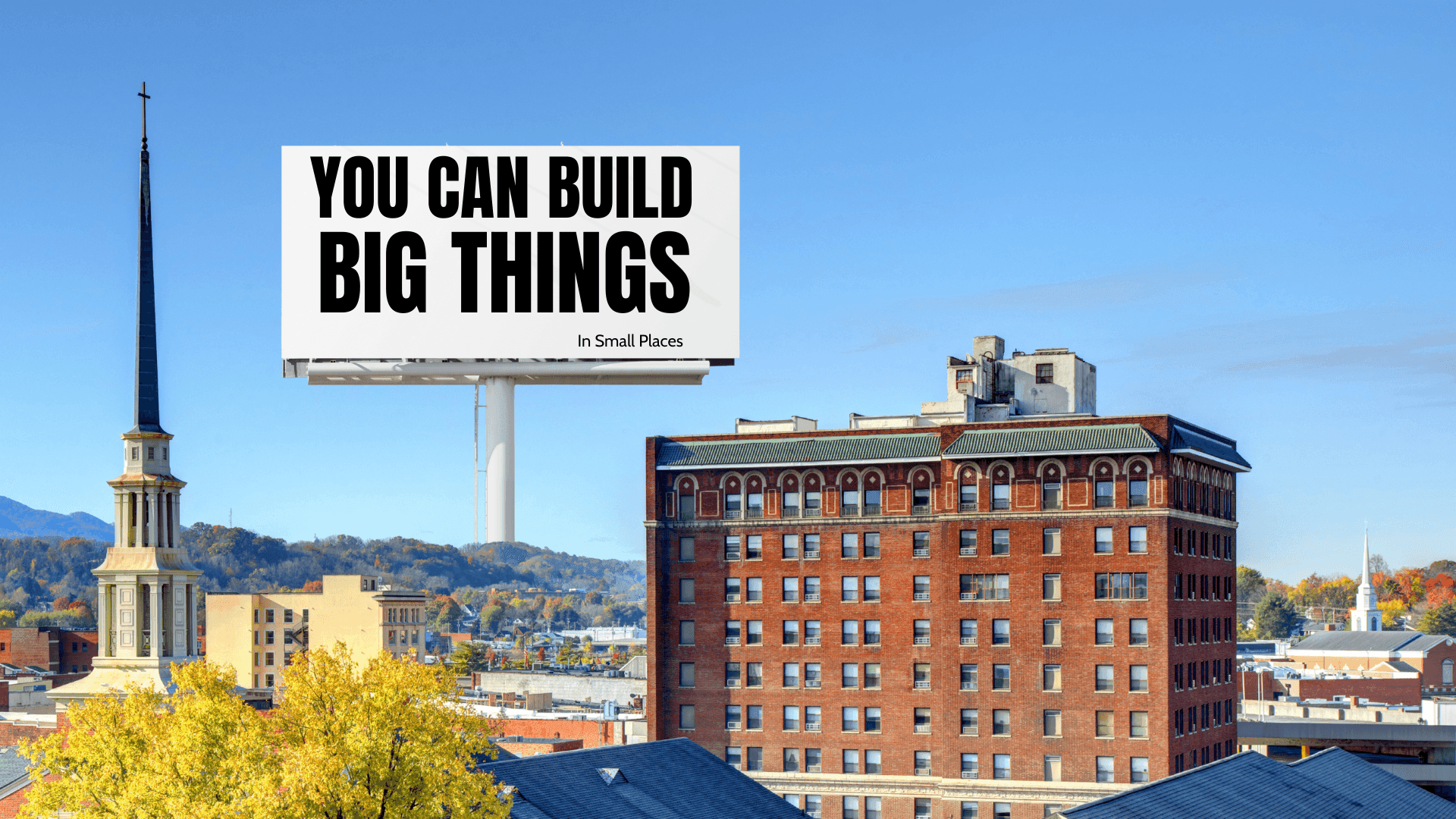
You Can Build Big Things In Small Places
by Emma Ayala | | Startup Advice
For a long time, success has been sold as a departure.
If you want to build something meaningful, the advice is almost always the same: move. Bigger city. Bigger market. Bigger network. The message is subtle but constant—staying put is framed as thinking small, limiting your potential, or holding yourself back.
But every day, I see founders in my small town reframing that damaging narrative.
One of the clearest examples is Dave Hatley, Founder and CEO of LPI, Inc., and a Startup Mountain Summit speaker who shared his story with us in 2025. Dave built his company from the ground up with zero debt and now employs over 700 people in our region, with an average salary of around $88,000.
Rather than chasing growth by leaving, he chose to build right here in Johnson City—what he calls “the best place on earth.” By manufacturing locally, hiring from the community, and reinvesting in the place that shaped him, he’s created massive success. He’s also gained real advantages: manufacturing in-house has saved his company thousands of dollars, helped maintain quality, and made a tangible impact on the local economy.
He became the change he wanted to see.
And he’s not alone.
Personality Pool, founded by Lauren Glass Mullins—also a Tri-Cities native—was the first company to be funded by Launch Tennessee’s investment fund. Along with the recent success of local startups like Green Llama, these stories continue to challenge the idea that success only happens in New York, Los Angeles, or Miami.
So I decided to break down that myth.
Because the reality is this: if you have an idea you truly care about, you can build it anywhere. That place might be your kitchen table, a boarded-up building on Main Street, or your local coffee shop.
So why is there such a stigma around staying where you are—when applying to colleges, choosing post-grad jobs, or starting a company?
Because the place you’re in hasn’t seen that kind of success yet.
And this belief doesn’t stay at the individual level. When repeated long enough, it becomes a dangerous system—one that exports ambition, lowers expectations for everyone who stays, and strips top talent of the competition they need to grow, improve, and stay motivated.
This is dangerous because it doesn’t just limit opportunity, it reshapes behavior. When ambition is expected to leave, staying begins to feel like settling. Standards drop not because people lack talent, but because there’s no visible reason to push harder. Without competition, even high-potential people plateau. Growth slows. Motivation fades.
Let me tell you a story.
When I was in fifth grade in South Florida, many of my friends went to a school called Driftwood. It had an incredible reputation, and parents were willing to drive farther so their kids could attend it instead of the conventional option—Attucks Middle School. Attucks was struggling with enrollment, had a bad reputation, and was located in a lower-income area.
But what people overlooked was its potential.
It was an old high school facility with incredible resources: a track, a swimming pool, a multimillion-dollar TV production room—and most importantly, a group of faculty and staff who deeply cared about the students and the community.
At the time, I was devastated that I wouldn’t be going to Driftwood, the “superior” school in the nice suburb. But in hindsight, attending Attucks was one of the best things I could have done for my future. What held me back was believing success existed somewhere else, farther away.
That simply wasn’t true. My quality of education at Attucks was better than it would have been at Driftwood.
My mom told me something then that still sticks with me:
“It doesn’t matter what school you go to. It’s the kid and the effort they put in. You can have all the resources in the world, but if you don’t bring your own drive, it doesn’t matter where you are.”
That lesson applies to far more than school.
At the time, I couldn’t see how much environment shapes confidence. When expectations are low, effort feels unnecessary. When effort is rare, excellence feels uncomfortable. Attucks worked because the people inside it refused to accept the narrative surrounding it. That same dynamic applies to towns, campuses, and startup ecosystems everywhere.
When a community internalizes the idea that opportunity exists elsewhere, effort begins to feel optional. If a college student looks around and sees that none of their peers are networking, attending clubs, or building things outside of class, why would they?
In environments where ambition is rare, doing more than required can even feel risky. You don’t want to be “that person.” But avoiding standing out comes at a cost. It delays skill-building, confidence, and exposure—things that compound over time. When doing slightly more makes you stand out, there’s little incentive to go further.
But the moment you leave that environment, reality hits.
When students graduate, apply for jobs, or try to start companies, they’re suddenly competing against people raised in communities where extracurricular involvement, networking, and initiative are standard—not exceptional. In those spaces, what once felt impressive is simply expected. The gap isn’t comming from a lack of intelligence or potential. It’s experience.
This is how the cycle reinforces itself.
Over time, the narrative that “you have to leave to succeed” drains communities of their most driven people, lowers the bar for those who remain, and removes the healthy competition required for growth and change.
But here’s the thing: those major entrepreneurial cities didn’t always have seven coworking spaces, ten investment firms, or endless pitch competitions. They built them—because enough people stayed, showed up, and demanded more.
And if you’re not willing to build, the least you can do is support the people who are.
There is nothing more frustrating than seeing someone identify a real need—starting a club, hosting events, pioneering a conference—only to watch the very people they’re trying to help brush it aside and not show up. That’s where culture breaks down.
People complain about the lack of resources, access, and funding, but more often than not, the real issue is participation. Opportunity can’t scale without belief, effort, and community buy-in.
So when you see someone trying to make a difference, don’t just say, “I hope they succeed.” Ask yourself, “How can I help make this successful?”
Because if the first few efforts fail and everyone says, “See, we told you—things like that don’t happen here,” then you’re not just observing the problem.
You’re actively sustaining it.
Ready for another informative article?
Check out this selection below!

From Church Band Guitar to a Full-Time Music Career
by Emma Ayala | Jul 30, 2026 | Startup Advice
Trevin Sluss quit his day job three years ago with nothing but a guitar, a following, and a plan. Booked 29 times this July, he's running a one-person business, proof that entrepreneurship comes in all different shapes and sizes around here, from grocery stores to singing.
Read More: From Church Band Guitar to a Full-Time Music Career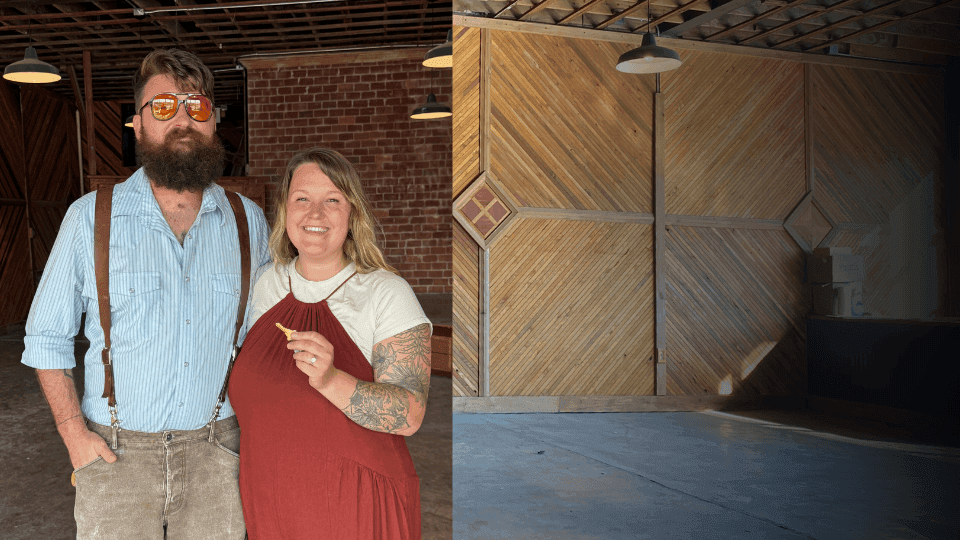
Wants You to Meet Your Farmer
by Emma Ayala | Jul 30, 2026 | Startup Advice
Ariel and Zach White are opening a bulk grocery store on W. Walnut Street, and they want you to walk out knowing whose hands grew what's in your cart, and how to actually use it.
Read More: Wants You to Meet Your FarmerFrom Church Band Guitar to a Full-Time Music Career
by Emma Ayala | Jul 30, 2026 | Startup Advice
Trevin Sluss quit his day job three years ago with nothing but a guitar, a following, and a plan. Booked 29 times this July, he's running a one-person business, proof that entrepreneurship comes in all different shapes and sizes around here, from grocery stores to singing.
Read More: From Church Band Guitar to a Full-Time Music CareerWants You to Meet Your Farmer
by Emma Ayala | Jul 30, 2026 | Startup Advice
Ariel and Zach White are opening a bulk grocery store on W. Walnut Street, and they want you to walk out knowing whose hands grew what's in your cart, and how to actually use it.
Read More: Wants You to Meet Your Farmer